

Blog
5 things that surprised us about where fat goes
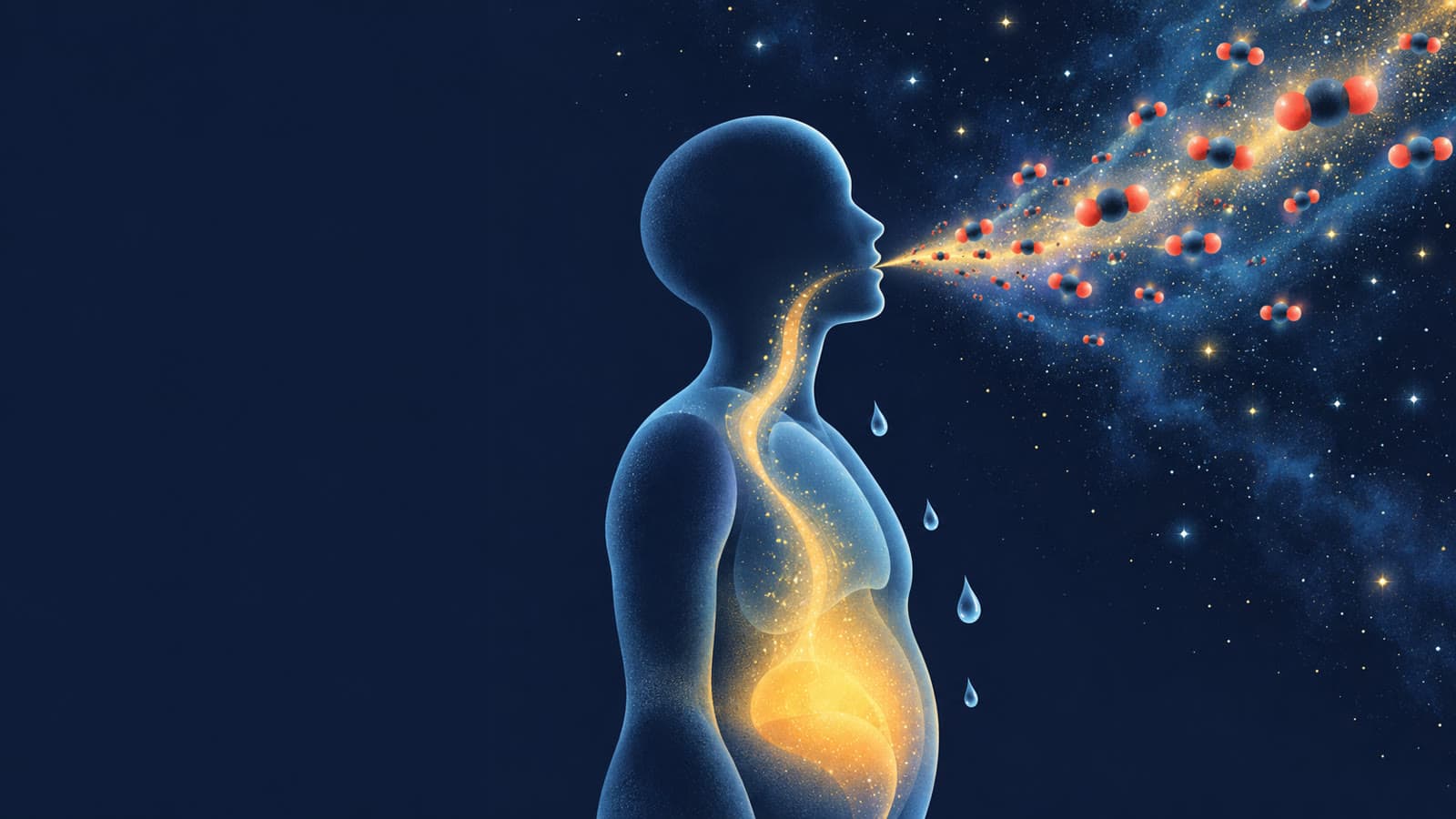
Illustration made with AI (OpenAI)
To lose 10 kg of fat you breathe in 29 kg of oxygen, and your fat cells shrink instead of disappearing. Five sourced surprises.
By Science for Big BabiesPublished 3 min read
Making our episode on where fat goes when you lose weight, we read the paper behind the famous answer, a 2014 BMJ article by Ruben Meerman and Andrew Brown, plus the studies around it. The short answer is that most lost fat leaves in your breath, as carbon dioxide. These are the five details that surprised us most along the way.
1. Losing 10 kg of fat takes 29 kg of oxygen
To lose 10 kg of fat, you breathe in 29 kg of oxygen, almost three times the weight of the fat.
Your cells don't burn fat with a flame, but the chemistry is the same as burning: fat combines with oxygen and becomes carbon dioxide and water. For 10 kg of fat, Meerman and Brown calculate 29 kg of inhaled oxygen, producing 28 kg of carbon dioxide and 11 kg of water. (BMJ 2014)
2. 39 kilos in, 39 kilos out
Fat plus oxygen weighs 39 kg, and so does the carbon dioxide plus water that comes out.
10 kg of fat and 29 kg of oxygen go in; 28 kg of carbon dioxide and 11 kg of water come out. Nothing turns into energy and vanishes: the energy is released as the atoms rearrange, and the atoms themselves still have to leave. Follow only the fat's own atoms and 8.4 kg of every 10 kg leaves as carbon dioxide, 1.6 kg as water. (BMJ 2014)
There's a twist inside that split. The average fat molecule, C55H104O6, has 6 oxygen atoms: 4 leave in your breath and 2 end up in water. And if you count atoms instead of weighing them, the picture flips: 106 of the molecule's 165 atoms, all 104 hydrogens plus 2 oxygens, end up in water. Hydrogen is so light that those 106 atoms make up only 16% of the weight.
3. Your fat cells shrink, but they stay
Lose weight as an adult and you keep the same number of fat cells; they just get smaller.
A 2008 study in Nature found that the number of fat cells stays constant in adults, lean or obese, even after marked weight loss, and that the number is set during childhood and adolescence. The cells still turn over: about 10% of them are renewed every year. (Spalding et al., Nature 2008) In a 2014 study of 62 women followed for two years after gastric bypass surgery, body weight fell by 33% and fat cells got smaller, not fewer. (Andersson et al., Diabetes Care 2014)
4. On a quiet day you breathe out about 200 g of carbon
A resting 70 kg adult breathes out about 203 g of carbon on a day of sleep, rest and light activity.
That's 0.74 kg of carbon dioxide. At rest, each breath carries about 33 mg of it. Swap one hour of rest for a jog and you breathe out an extra 39 g of carbon, about 20% more for the day. A single 100 g muffin covers about 20% of an average person's daily energy needs, which is why the paper concludes that exercise alone is easily undone by small amounts of extra food. (BMJ 2014)
And no, breathing faster doesn't help. Your cells make carbon dioxide when they use fuel; extra breaths only flush out what's already in your blood, which can leave you lightheaded, dizzy or tingly. (MedlinePlus, UNSW)
5. Sit-ups don't burn belly fat on their own
Exercising one body part doesn't take the fat from that part.
Fat leaves its cells into the blood, and the blood carries it to tissues all over the body. (Young & Zechner 2013) In one trial, six weeks of abdominal exercise alone didn't reduce belly fat. (Vispute et al. 2011) In another, people who trained one leg for 12 weeks lost fat from their arms and trunk, not from the trained leg. (Ramírez-Campillo et al. 2013) A 2022 meta-analysis of 13 studies with 1,158 participants found no spot reduction. (Ramirez-Campillo et al. 2022)
See it for yourself
The full episode follows one fat molecule from a fat cell to your breath in under ten minutes. On the episode page you can read the whole story with every source, listen to the audio version, and play Pack the atoms out, where you take a fat molecule apart yourself.
This is chemistry, not diet or medical advice.