

biology
When you lose weight, where does the fat go?
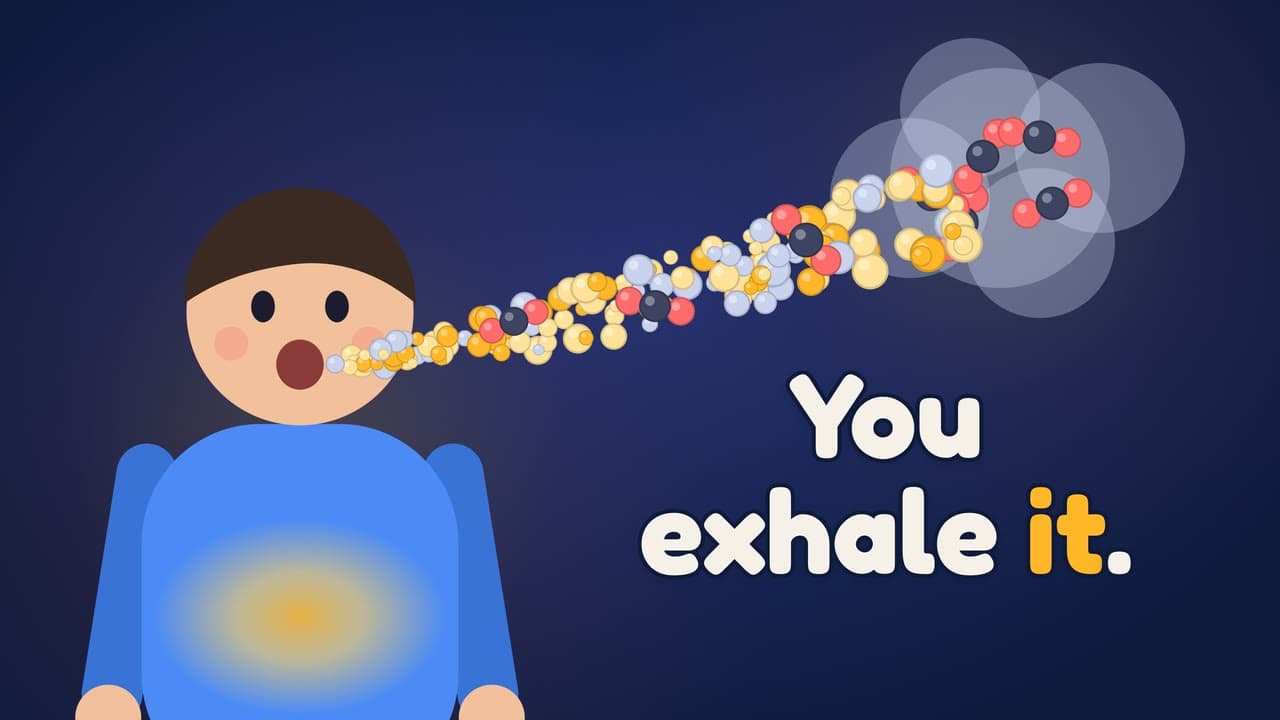
Fat doesn't turn into energy. Of every 10 kg of fat you lose, about 8.4 kg leaves as carbon dioxide you breathe out and 1.6 kg as water.
By Science for Big BabiesUpdated 11 min read
Before you start
You lose 10 kg of fat. Where does most of it go?
Take a guess. There's no score, and you'll see your guess again at the end of the quiz.
Playing the video loads it from YouTube, which sets its own cookies. Privacy
Key takeaways
Fat doesn't vanish and doesn't turn into energy. Its atoms leave as carbon dioxide and water, and the energy is released as those atoms rearrange. 1
By weight, 84% of lost fat is exhaled as carbon dioxide and 16% leaves as water. 1
Using up 10 kg of fat takes 29 kg of inhaled oxygen and produces 28 kg of carbon dioxide and 11 kg of water. 1
The full story
When you lose weight, most of the lost fat leaves your body in your breath, as carbon dioxide. Your cells combine the fat with oxygen and break it down into carbon dioxide and water. Of every 10 kg of fat you lose, about 8.4 kg is breathed out and about 1.6 kg leaves as water. 1
Those numbers come from a 2014 paper in the BMJ by Ruben Meerman and Andrew Brown, who worked out where each atom of a fat molecule ends up. 1 This page starts with a campfire, then follows one fat molecule from a fat cell to your lungs, puts the whole reaction on a scale, and ends with the question everyone asks next: why not just breathe faster?
Start with a campfire
Picture a big log on a campfire. By morning most of it is gone. The grey heap left behind is small: firewood leaves only about 1% of its dry weight as ash. 21
So where did the rest of the wood go? Into the air. Wood is made mostly of carbon, hydrogen and oxygen, and burning it produces mainly carbon dioxide and water, which drift away as gases. 21 The fire also kept you warm, and that warmth is energy. But the wood itself did not turn into heat. Its atoms were rearranged into new molecules, and those molecules left. Mass doesn't disappear in a chemical reaction. 1
Now swap the log for your body. Fat is your stored fuel: it is kept in fat tissue until your body needs energy. 6 To use it, your body needs oxygen, which you breathe in, just as a fire needs air. 1 The products are the same two simple things the fire made, carbon dioxide and water. 1
The water leaves the way water always does: in urine, sweat, breath and tears, and some in faeces. 1 The carbon dioxide travels in your blood to your lungs, and you breathe it out. 8 That is the whole simple answer. Your lungs are the main exit for lost fat. 1
The campfire picture is good, but it breaks in a few places that matter. We'll come back to them once the chemistry is on the table.
What most people get wrong
Meerman and Brown asked general practitioners, dietitians and personal trainers where lost fat goes, and found widespread misconceptions. 1 The most common answer was that fat is converted to energy or heat. Other answers were that it leaves in faeces or turns into muscle. 1
The energy answer is an easy mistake, because using fat really does release energy. The authors suspect the "energy in, energy out" mantra, and the focus on energy production in university biochemistry courses, are behind it. 1
Why fat can't simply become energy
Fat turning into energy would break the law of conservation of mass. 1 In a chemical reaction no atoms are destroyed; they only swap partners. So every atom in the fat you lose is still there afterwards and has to leave your body somehow. 1
Physics adds one footnote. Any release of energy comes with a tiny loss of mass, by E = mc². Food-energy tables give fat about 37 kJ per gram 14, so 10 kg of fat holds about 370 million joules. Divide that by the speed of light squared 20 and you get roughly 4 micrograms: four millionths of a gram, out of ten thousand grams. 14 20 Everything else leaves as matter.
Why fat can't simply become muscle
Muscle is built from proteins, proteins are built from amino acids, and every amino acid carries an amino group containing nitrogen. 11 The average fat molecule, C55H104O6, has no nitrogen at all. 1 So fat can't simply turn into muscle protein. These sources settle the composition question only; they don't track whether any of fat's carbon ends up in other molecules along the way.
The faeces answer, half right
Some of the water made from fat can leave in faeces. 1 The fat itself does not; Meerman and Brown list "excreted in the faeces" among the misconceptions. 1
Follow one fat molecule out of your body
Stored fat sits inside fat cells as triglycerides, the most efficient form for storing and transporting fatty acids. 5 A triglyceride is a glycerol backbone holding three fatty acid chains. 5 6 An average one in human fat has 55 carbon atoms, 104 hydrogens and just 6 oxygens. 1
Step 1: the fat cell lets go
When your body needs fuel, signals from nerves and hormones switch on the breakdown. 5 22 Among hormones, the catecholamines, the family adrenaline belongs to, are the most important activators of one of the key enzymes. 5
Three enzymes then take the triglyceride apart in sequence. ATGL makes the first cut, HSL mainly handles the second, and MGL finishes the job, leaving free fatty acids and glycerol. 5 This splitting is called lipolysis. 5 6 The glycerol enters glycolysis, a separate pathway. 6
Step 2: into the blood
The fatty acids leave the fat cell into the bloodstream, ride on a blood protein called albumin, and eventually enter tissues around the body. 5 Not every tissue uses them equally: the brain uses fatty acids only poorly as fuel. 23
Step 3: chopped up in the mitochondria
Inside a cell, a fatty acid is carried across the membrane of a mitochondrion, where all of its oxidation takes place. 6 13 A process called beta-oxidation chops it into two-carbon acetyl pieces, carried as acetyl-CoA. 6 9
Those pieces feed the citric acid cycle in the inner space of the mitochondrion, the matrix. Every turn of the cycle releases two molecules of carbon dioxide. 9 Turn after turn, this is where the fat's carbon becomes the gas you will breathe out. 1 9
The hydrogens take another route. Their electrons are passed along the electron transport chain to oxygen, the final electron acceptor, and that oxygen picks up hydrogen ions to form water. 10
Step 4: out through the lungs
Carbon dioxide is a waste product of cellular respiration. 8 In the blood, about 70% of it travels as bicarbonate, about 20% bound to hemoglobin, and 7 to 10% dissolved. 8 At the lungs it is released and breathed out. 8
Put 10 kg of fat on a scale
Meerman and Brown wrote the whole reaction for an average human triglyceride 1:
C55H104O6 + 78 O2 → 55 CO2 + 52 H2O + energy
Scaled up to 10 kg of fat, both sides weigh the same 1:
| Goes in | Mass | Comes out | Mass |
|---|---|---|---|
| Fat | 10 kg | Carbon dioxide | 28 kg |
| Oxygen you breathe in | 29 kg | Water | 11 kg |
| Total | 39 kg | Total | 39 kg |
The oxygen outweighs the fat almost three to one. 1
Now follow only the atoms that started in the fat. All 55 carbons end up in carbon dioxide, and all 104 hydrogens end up in water. The fat's 6 oxygens split in a 2:1 ratio: four are exhaled in carbon dioxide and two form water. 1 Add up the masses and 84% of the fat leaves as carbon dioxide and 16% as water, which is 8.4 kg and 1.6 kg out of 10 kg. 1
The rest of those 28 kg of carbon dioxide comes from the oxygen you breathed in. 1 So inhaled oxygen ends up in both products: in the carbon dioxide and in the water. 1
By weight, not by atom count
The 84% is a share of the mass. Count atoms instead and the picture flips: 106 of the molecule's 165 atoms, all 104 hydrogens plus 2 oxygens, end up in water. 1 Hydrogen atoms are so light that those 106 atoms add up to only 16% of the weight.
One more caveat from the paper: the calculation ignores fat that can leave as ketone bodies under particular physiological or disease conditions. 1
Where the energy goes
Fat is a dense fuel. Food-energy tables use 37 kJ (9 kcal) per gram of fat, against 17 kJ (4 kcal) per gram of carbohydrate. 14
When fat is oxidized, your cells catch part of the released energy in carrier molecules, most often ATP and NADH. 13 Around 60% of the energy produced while making ATP comes out as heat, which keeps your body at its working temperature. 7 So the energy and the atoms leave by separate routes: the energy as heat and in carrier molecules, the atoms as carbon dioxide and water. 1 7 13
Where the campfire analogy breaks
There is no flame inside you. In cells, enzymes run the oxidation as a series of small steps, so the reaction can happen at body temperature. 13
A log leaves ash. Fat that is used up completely leaves nothing behind but carbon dioxide and water. 1 21
The biggest difference is what's left of the container. A burned log is gone, but your fat cells stay and shrink. A 2008 study in Nature found that adults keep a constant number of fat cells, whether lean or obese, even after marked weight loss, and that the number is set during childhood and adolescence. 3 The cells still turn over: about 10% of fat cells are renewed every year, at all adult ages and body sizes. 3
A 2014 study followed 62 women with obesity for two years after gastric bypass surgery. Their body weight fell by 33%, and their fat cells got smaller but not fewer. 4
Can you burn fat from one spot?
Fat leaves its cells into the blood, and the blood carries it to tissues all around the body. 5 Exercise trials find what that route suggests.
In one trial with 24 healthy, inactive adults, six weeks of abdominal exercise alone did not reduce the fat under the skin of the belly. 17 In another, 11 people trained one leg for 12 weeks. They lost fat, but from their arms and trunk, not from the trained leg. 18 A 2022 meta-analysis pooled 13 studies with 1,158 participants aged 14 to 71 and found no spot reduction. 19
Why breathing faster won't burn more fat
Think of carbon dioxide as the trash in your kitchen. Cooking fills the bin; taking the bag out more often doesn't cook anything. In your body, the cooking is your cells using fuel, which makes carbon dioxide as a waste product. 8 Breathing out only carries the bag outside.
Breathe faster than your body needs and you mostly just empty the bin early, lowering the carbon dioxide in your blood. 16 This is where the trash picture breaks: an empty bin is harmless, but your body notices when blood carbon dioxide drops. Rapid, deep breathing, called hyperventilation, can leave you lightheaded, dizzy, weak, numb or tingly. 16 Asked whether simply breathing more can make you lose fat, the study authors' university answers: no. 2
The numbers for a resting 70 kg person
At rest, an average 70 kg person on a mixed diet breathes out about 200 ml of carbon dioxide a minute, in about 12 breaths. 1 Each breath carries about 33 mg of carbon dioxide, and 8.9 mg of that is carbon. 1
Over a day of 8 hours' sleep, 8 hours' rest and 8 hours of light activity that doubles the resting rate, that person breathes out 0.74 kg of carbon dioxide, removing 203 g of carbon. 1 For comparison, 500 g of table sugar contains 210 g of carbon and 2,000 kcal of energy. 1
To breathe out more carbon, your cells have to use more fuel. Replacing one hour of rest with jogging, at about seven times the resting rate, removes an extra 39 g of carbon and lifts the day's total by about 20%, to 240 g. 1
Food puts the carbon back
Every meal brings carbon back in. A single 100 g muffin covers about 20% of an average person's daily energy needs. 1 Meerman and Brown conclude that physical activity as a weight-loss strategy is easily undone by relatively small amounts of extra food, and their paper lands on the old line "eat less, move more". 1
Underneath the carbon bookkeeping sits energy balance. Body weight change is tied to a gap between the energy in the food you eat and the energy you spend, and human physiology obeys the first law of thermodynamics. 15 Resting energy expenditure makes up about two thirds of the energy you spend, and a change in one part of the balance tends to cause compensating changes in the others. 15
This page explains the chemistry of fat loss. It is not diet or medical advice.
Where the carbon goes next
Plants take carbon dioxide from the air through small pores called stomata and use it, with water and sunlight, to build energy-storing carbohydrates. 12 So some of the carbon that once sat in your fat might one day be part of a tree.
Mini course · 4 lessons · about 9 min
Learn it step by step
Short lessons at your own pace: guess first, then see why, try the lab, and check yourself at the end of each lesson.
- Explain why lost fat can't simply turn into energy
- Follow a fat molecule from a fat cell to your breath
- Say why breathing faster doesn't burn more fat
- Explain why fat cells shrink and spot reduction doesn't work
- 1. Think of a campfire
- 2. Why fat can't become energy
- 3. Follow one fat molecule
- 4. Breathing, exercise and fat cells
Listen
Audio version
When you lose weight, where does the fat go?
Chapters
Transcript
Game · about a minute
Pack the atoms out
This is one average fat molecule, C55H104O6. Lose fat and every one of its 165 atoms has to leave your body. Send each pack to the right exit and watch where 10 kg of fat ends up.
Fat molecule · 165 atoms left
carbonhydrogenoxygen
Drag each atom pack to an exit, or tap a pack and then tap an exit. Keyboard: pick a pack, then press B for breath or W for water.
Numbers: Meerman & Brown, BMJ 2014, for an average human fat molecule. The game packs carbon in elevens and hydrogen in thirteens to keep it short; the oxygens go one by one.
Try it
1. Follow the atoms
Pick how much fat you lose. Matter can't vanish, so everything that goes in has to come out.
In
= 39.0 kg
Out
= 39.0 kg
Where the fat itself ends up
84% leaves through your lungs, 16% as water.
2. Can you just breathe it away?
Change how fast you breathe, then how much you move. Watch the carbon that leaves your body today.
Carbon breathed out today
203 g
Dizziness
Try breathing faster first. Then try moving.
Estimates from Meerman & Brown, BMJ 2014, for an average person. Real bodies vary; this lab only shows the idea.
Did it stick?
Open the quiz on its own pageQuestion 1 of 8
You lose 10 kg of fat. By weight, most of it leaves your body as…
Questions people also ask
Do you really breathe out fat?
Mostly, yes, but not as fat. Your cells break fat down with oxygen into carbon dioxide and water. The fat's carbon leaves inside carbon dioxide molecules that you exhale. By weight, about 8.4 kg of every 10 kg of fat lost is breathed out and 1.6 kg leaves as water, according to Meerman and Brown's 2014 calculation in the BMJ. 1
Does fat turn into energy or heat?
No. Using fat releases energy, and around 60% of the energy produced while making ATP ends up as body heat. 7 The fat's atoms are not destroyed, though: they are rearranged into carbon dioxide and water and leave your body. 1 By E = mc², all the energy in 10 kg of fat corresponds to only about 4 micrograms of mass. 14 20
Does fat leave your body through sweat or urine?
Can breathing faster help you lose weight?
No. Carbon dioxide is made by your cells when they use fuel. 8 Breathing faster than you need only flushes out carbon dioxide already in your blood, which can make you lightheaded, dizzy, numb or tingly. 16 To breathe out more carbon, your cells must use more fuel: swapping an hour of rest for a jog removes about 39 g of extra carbon. 1
Do fat cells disappear when you lose weight?
No. In adults the number of fat cells stays roughly constant, even after large weight loss; the cells shrink instead. 3 4 The number is set during childhood and adolescence, and about 10% of fat cells are replaced each year. 3 In one study, women who lost a third of their body weight after gastric bypass had smaller fat cells, not fewer. 4
Can sit-ups burn belly fat?
Not on their own. In a six-week trial, abdominal exercise alone did not reduce belly fat. 17 People who trained one leg for 12 weeks lost fat from their arms and trunk, not from that leg. 18 A 2022 meta-analysis of 13 studies found no spot reduction. 19 Fat released from fat cells travels in the blood to tissues around the body. 5
How we know
The main source. Almost every number on this page comes from one peer-reviewed paper: Ruben Meerman and Andrew Brown, When somebody loses weight, where does the fat go?, published in the BMJ in 2014. 1 On 30 October 2026 we checked our numbers against the published paper: the 70 kg reference person, 12 breaths a minute, 33 mg of carbon dioxide and 8.9 mg of carbon per breath, 0.74 kg of carbon dioxide and 203 g of carbon in a quiet day, 39 g of extra carbon for an hour of jogging, 29 kg of oxygen, 28 kg of carbon dioxide and 11 kg of water for 10 kg of fat, the 84% and 16% split, 4 of 6 oxygens to your breath, and the formula C55H104O6.
A correction to that paper. On 19 December 2014 the BMJ published a correction (BMJ 2014;349:g7782): in figure 2, the number in pale blue above H2O should be 9.4 kg, not 8.4 kg. That number is the water made from inhaled oxygen. We don't use it anywhere. The 8.4 kg that leaves as carbon dioxide and the 1.6 kg that leaves as water, both counted from the fat itself, are not affected.
What we could only read in part.
- The fat cell findings come from a 2008 study in Nature and a 2014 study in Diabetes Care. 3 4 We read their abstracts; the full texts are behind paywalls.
- The spot-reduction trials and the 2022 meta-analysis are also cited from their abstracts. 17 18 19 The first two trials are small: 24 and 11 people.
- The "4 of 6 oxygens go to your breath" split is stated in the BMJ paper, which bases it on a 1949 heavy-oxygen study by Lifson and colleagues. We couldn't open that older paper, so we rely on the BMJ's account of it.
Where a source is secondary.
- "Does breathing more burn more fat? No" is the answer given in the University of New South Wales press release about the paper. 2 It fits basic physiology: carbon dioxide is made by cells using fuel, and over-breathing only lowers it in your blood. 8 16
- The press release also says more than half of 150 doctors, dietitians and personal trainers surveyed thought fat turns into energy or heat. That figure isn't in the paper itself, so we don't use it. The paper only says it found widespread misconceptions among those groups. 1
What we worked out ourselves. "About 4 micrograms" is our own calculation: 10 kg of fat at 37 kJ per gram 14, divided by the speed of light squared 20. "39 kilos in, 39 kilos out" is the paper's own numbers added up: 10 + 29 and 28 + 11. 1
The analogies. The campfire is our comparison, not the paper's. The fact behind it, that firewood leaves only about 1% of its dry weight as ash, comes from university extension and forestry sources. 21 We say where each analogy breaks: no flame, no ash, and fat cells that shrink instead of vanishing.
What we didn't use. The paper's figures are under a non-commercial licence, so every drawing in the video is our own. Nothing here is diet or medical advice.
Sources
Every claim in the video and the article comes from these sources.
- Meerman R, Brown AJ. When somebody loses weight, where does the fat go? BMJ 2014;349:g7257
- UNSW Sydney Newsroom: When we lose weight, where does the fat go? (17 December 2014)
- Spalding KL, Arner E, Westermark PO, et al. Dynamics of fat cell turnover in humans. Nature 2008;453:783-787
- Andersson DP, Eriksson Hogling D, Thorell A, et al. Changes in subcutaneous fat cell volume and insulin sensitivity after weight loss. Diabetes Care 2014;37(7):1831-1836
- Young SG, Zechner R. Biochemistry and pathophysiology of intravascular and intracellular lipolysis. Genes Dev 2013;27(5):459-484
- OpenStax, Anatomy and Physiology 2e, 24.3 Lipid Metabolism (2022)
- OpenStax, Anatomy and Physiology 2e, 24.6 Energy and Heat Balance (2022)
- OpenStax, Anatomy and Physiology 2e, 22.5 Transport of Gases (2022)
- OpenStax, Biology 2e, 7.3 Oxidation of Pyruvate and the Citric Acid Cycle (2018)
- OpenStax, Biology 2e, 7.4 Oxidative Phosphorylation (2018)
- OpenStax, Biology 2e, 3.4 Proteins (2018)
- OpenStax, Biology 2e, 8.1 Overview of Photosynthesis (2018)
- Alberts B, et al. Molecular Biology of the Cell, 7th edition, chapter 2. Norton
- FAO. Food energy: methods of analysis and conversion factors. Food and Nutrition Paper 77, Rome 2003, chapter 3
- Hall KD, Heymsfield SB, Kemnitz JW, et al. Energy balance and its components: implications for body weight regulation. Am J Clin Nutr 2012;95(4):989-994
- MedlinePlus Medical Encyclopedia: Hyperventilation. U.S. National Library of Medicine
- Vispute SS, Smith JD, LeCheminant JD, Hurley KS. The effect of abdominal exercise on abdominal fat. J Strength Cond Res 2011;25(9):2559-2564
- Ramírez-Campillo R, Andrade DC, Campos-Jara C, et al. Regional fat changes induced by localized muscle endurance resistance training. J Strength Cond Res 2013;27(8):2219-2224
- Ramirez-Campillo R, Andrade DC, Clemente FM, et al. A proposed model to test the hypothesis of exercise-induced localized fat reduction (spot reduction), including a systematic review with meta-analysis. Human Movement 2022;23(3):1-14
- NIST CODATA: speed of light in vacuum
- Sadaka S, Johnson DM. Biomass Combustion, FSA1056, University of Arkansas Extension; Kofman PD. Wood ash, COFORD Connects, 2016
- Bartness TJ, et al. Front Neuroendocrinol 2014 (PMC4175185)
- Schönfeld P, Reiser G. 2013 (PMC3790936)
Spotted a mistake? Here's how we fix it.